
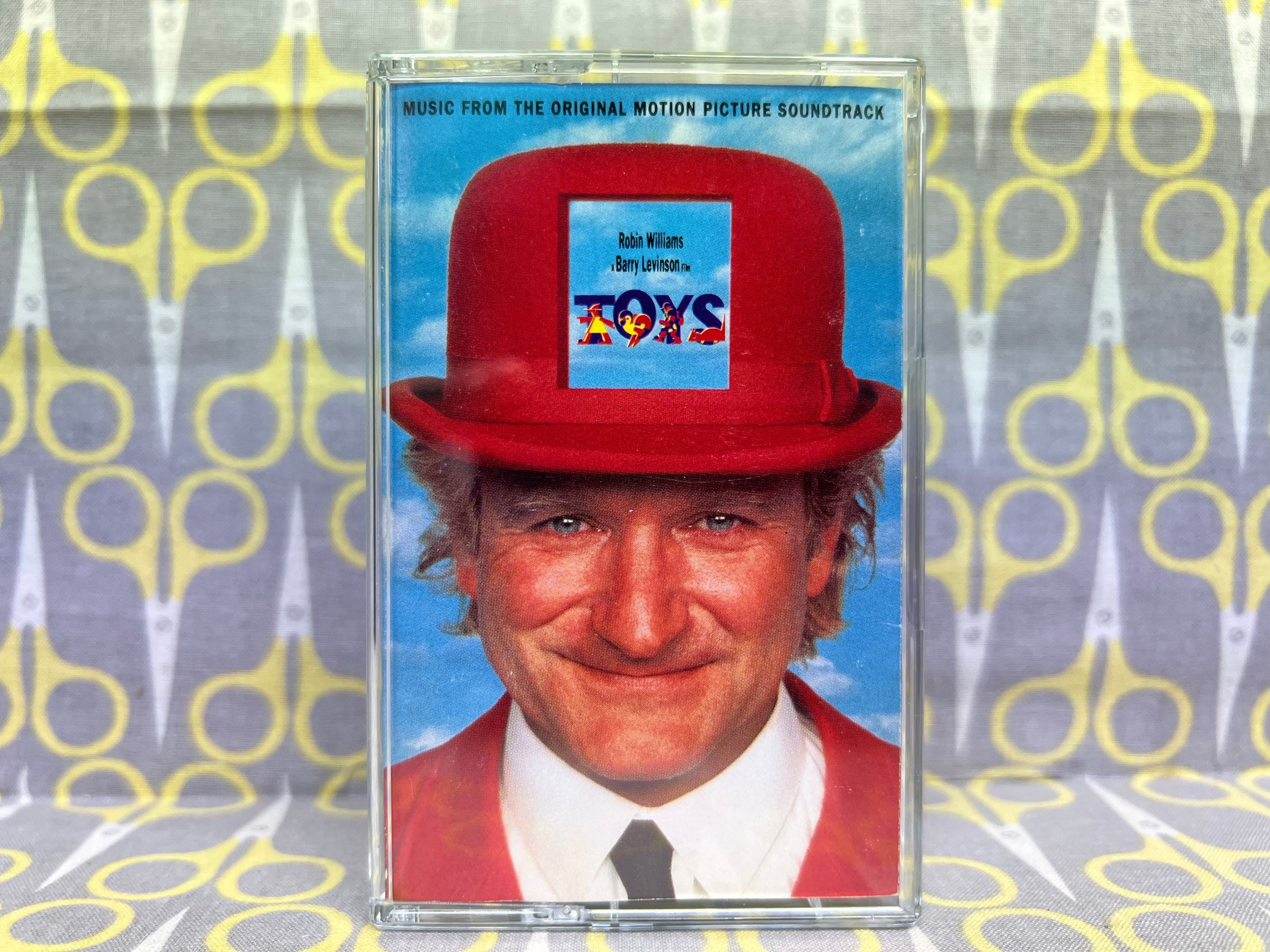
When Barry Levinson debuted “Toys” in 1992, audiences encountered an offbeat comedy coated in vivid imagery and surreal whimsy, and today many viewers returning to the film are realizing how its portrayal of tech-powered warfare now appears strikingly real.
For years, “Toys” was regarded as one of Hollywood’s most unusual commercial misfires, a film directed by Barry Levinson and featuring Robin Williams, Joan Cusack, LL Cool J and Michael Gambon that entered the crowded early‑1990s holiday season buoyed by major studio support and lofty expectations, yet, even with its notable cast, bold production design and inventive visuals, it ultimately faced both critical resistance and lackluster box office results.
Over time, the film faded from mainstream discussion and became increasingly difficult to find on modern streaming platforms. Unlike many cult classics that enjoy steady rediscovery through television reruns or digital services, “Toys” nearly disappeared from public conversation for years. However, the rise of online clips and social media discussions has unexpectedly brought renewed attention to the film, especially as global warfare increasingly incorporates drones, remote operations and gamified military technology.
Many viewers now feel the film foreshadowed elements of contemporary warfare long before they dominated daily news, turning what seemed far-fetched or overstated in 1992 into something eerily credible in an age shaped by artificial intelligence, virtual simulations and low-cost remote-operated weaponry.
The revived interest in “Toys” stems from more than simple nostalgia; it signals a wider cultural awareness that many of the film’s themes have grown strikingly relevant today. What was once a surreal portrayal of children engaging with militarized video games and remote warfare systems no longer reads as sheer fantasy. It now mirrors the technological trajectory that modern combat has steadily followed over the last twenty years.
A film that interwove youthful innocence with elements of militarization
At its core, “Toys” presents a deeply unusual premise. The story centers on a whimsical toy factory inherited by a military-minded executive named Leland Zevo, who gradually transforms the playful business into a secret weapons development operation.
What initially begins as harmless experimentation with toy-like military devices eventually evolves into something far more disturbing. The character becomes obsessed with creating smaller, cheaper and more technologically efficient tools for warfare. Hidden inside the colorful aesthetic of the film is a sharp critique of how entertainment technology and military innovation can slowly merge together.
A standout sequence in the film portrays children unknowingly taking part in simulated warfare via immersive video systems, convinced they are merely enjoying arcade-like games while, in reality, they are being conditioned to operate destructive machines from a distance. The boundary between play and real violence gradually dissolves until the young participants can no longer grasp the true impact of what they are doing.
At the time the film debuted, many viewers considered these ideas strange, as video game technology remained fairly rudimentary by modern standards and the notion of remote combat managed through on‑screen interfaces felt overstated, yet Barry Levinson later noted that he drew inspiration from early tech innovations already taking shape in the late 1980s and early 1990s.
Computers were becoming more common, remote-control devices were rapidly evolving and gaming culture was beginning to influence broader entertainment industries. According to Levinson, the film was never intended as a literal prediction of the future. Instead, it explored what could happen if existing technological trends continued advancing without ethical limits.
Why the film was misunderstood in its time
When “Toys” premiered, many critics and viewers struggled to categorize it. The movie combined fantasy, satire, dark comedy and anti-war commentary in ways that confused audiences expecting a more conventional Robin Williams comedy.
Its visual presentation further fueled the confusion, as the film showcased pastel-toned sets, surreal architecture, and dreamlike moments that echoed abstract theater rather than conventional Hollywood narratives, leading some viewers to read its playful design as a sign that it was aimed mainly at children, despite its strongly political and philosophical themes.
Barry Levinson later reflected that audiences in the United States had difficulty embracing the movie’s surrealism. European viewers, by contrast, appeared more receptive to its unusual tone and symbolic storytelling. In some countries, critics interpreted the film through the lens of absurdist art and satire rather than commercial family entertainment.
The film’s collapse also came at a moment when Hollywood viewers largely leaned toward simple action hits and broad comedies, and early‑1990s blockbusters mostly followed familiar genre formulas, but “Toys” never settled comfortably into any defined category.
Although the film initially underperformed at the box office, it slowly attracted a modest yet dedicated audience that valued its inventive approach and experimental spirit, and as time passed, critics started to reevaluate elements of the production, especially its bold visual style and the significance of its themes.
Today, many discussions surrounding “Toys” focus less on its initial box-office performance and more on how accurately it captured anxieties surrounding technology, media and warfare.
The rise of drone warfare and remote conflict
One reason the movie still strikes such a powerful chord today is that military operations have dramatically evolved throughout the 21st century, as modern warfare now leans heavily on drones, automated systems and remotely operated technologies that minimize the necessity for soldiers to face combat directly.
Conflicts in regions like Ukraine and the Middle East have shown that comparatively low‑cost drones can shift military power dynamics, as compact unmanned aerial vehicles now handle surveillance, precision strikes and strategic missions that previously demanded highly expensive aircraft and sizable crews.
This mirrors one of the central ideas explored in “Toys”: the economic efficiency of miniaturized warfare. In the film, Leland Zevo becomes fascinated by reducing the financial cost of military operations through compact, remotely controlled devices. What initially appears absurd now reflects genuine military strategies adopted around the world.
The growing use of drones has also transformed the psychological experience of warfare. Soldiers can now operate deadly systems from far away using screens, joysticks and digital interfaces similar to gaming technology. Critics and ethicists have warned that this distance may reduce emotional awareness of violence and make conflict appear less immediate or personal.
That concern sits at the heart of Levinson’s film. The children in “Toys” do not fully understand the consequences of their actions because warfare is presented to them as entertainment. The film suggests that technology can detach people from the human realities of destruction.
As military systems continue integrating virtual reality, AI-assisted targeting and autonomous weapons, the questions raised by the film feel increasingly urgent.
Technology, artificial intelligence and the erosion of reality
Beyond warfare, “Toys” also explored another issue that has become central in modern society: the difficulty of distinguishing reality from simulation.
Levinson recently voiced his unease about the ways artificial intelligence and sophisticated digital technologies are altering how people interpret what is real. He mentioned encountering an AI‑crafted video so convincingly produced that he first assumed it was authentic. That moment led him to reflect on how quickly digital fabrication might advance over the next ten years.
This anxiety ties closely to the film’s central themes, as “Toys” portrays characters drawn into virtual worlds where entertainment and reality merge until the line between them nearly vanishes, while today’s progress in AI-driven images, deepfakes and virtual simulations sparks comparable worries in the real world.
The increasing sophistication of digital environments means people are constantly interacting with experiences that may not be entirely authentic. Social media, gaming platforms and AI-generated content create immersive realities capable of influencing emotions, opinions and even political perceptions.
As these technologies become more accessible, society faces new ethical dilemmas surrounding trust, manipulation and accountability. Levinson’s film did not predict specific technological devices, but it accurately captured the broader direction of cultural and technological evolution.
Gaming culture, digital media, and military technology have become increasingly intertwined, a convergence that is particularly noticeable. Contemporary video game interfaces often mirror the look and feel of military control panels, and military training programs now frequently rely on simulation tools that were first created for entertainment.
Technological innovation often shifts seamlessly between civilian and military spheres, a convergence that becomes clear as recreational devices are later repurposed for surveillance, combat or strategic oversight.
The economic forces powering contemporary military technological progress
One of the film’s most compelling elements is how “Toys” highlights the economic rationale behind technological warfare, emphasizing throughout that advances in military technology arise not only from strategic demands but also from the pursuit of cost efficiency.
In the modern world, governments and defense industries constantly seek cheaper ways to maintain military power. Large fighter jets, tanks and traditional weapons systems are enormously expensive to build and maintain. Smaller autonomous technologies provide more affordable alternatives while still delivering destructive capability.
This economic landscape has hastened the adoption of drones, AI-supported platforms, and long‑range remote warfare tools, and the reduced cost of entry now enables nations and even smaller groups to tap into military technologies that once belonged solely to major powers.
Levinson noted that this pattern had already surfaced while “Toys” was being developed, pointing out that even in the earliest phases of computerization it was easy to envision how compact remote technologies might eventually be adapted for military use.
The film conveys this progression with satire and surreal touches, yet its core reasoning remains highly pragmatic. As combat can be carried out at lower cost, with greater efficiency, and with reduced immediate danger for operators, governments may grow more inclined to depend on these systems.
That prospect introduces complex ethical issues concerning responsibility and emotional distance, as the use of screens and automated systems to carry out violence can erode the psychological restraints traditionally linked to warfare.
Rediscovering a film that now feels strangely modern
The revived interest in “Toys” shows how some films gain fresh significance long after they first debuted, as works once dismissed as bizarre or implausible may come to feel unexpectedly perceptive with society’s evolution.
Many viewers revisiting the film today are struck by how closely some of its ideas resemble contemporary debates about AI, drone warfare, simulation technology and digital culture. The movie’s surreal tone no longer feels disconnected from reality. Instead, it mirrors the increasingly bizarre relationship modern society has with technology and conflict.
At the same time, “Toys” remains intentionally stylized and symbolic rather than purely realistic. Levinson never intended the movie to function as a literal forecast of future events. Instead, it explored the cultural anxieties emerging during a period of rapid technological transformation.
The film explored the potential consequences of entertainment, warfare, and digital systems merging into a single realm, and decades later those concerns have moved beyond the boundaries of pure science fiction.
Contemporary military engagements, digital simulations, and AI-shaped environments increasingly echo anxieties that once felt overstated within the vibrant, whimsical setting of “Toys.” What was once viewed as an awkward mix of fantasy and satire now reads less like a misfire and more like an early alert about the psychological fallout tied to advancing technology.
As artificial intelligence, virtual environments and autonomous systems continue reshaping everyday life, the film’s central message feels more relevant than ever: technology does not simply change how people interact with the world — it can fundamentally alter how they perceive reality itself.